CI/CD Pipeline Explained: Ultimate Beginner’s Guide with Real Examples (2026)
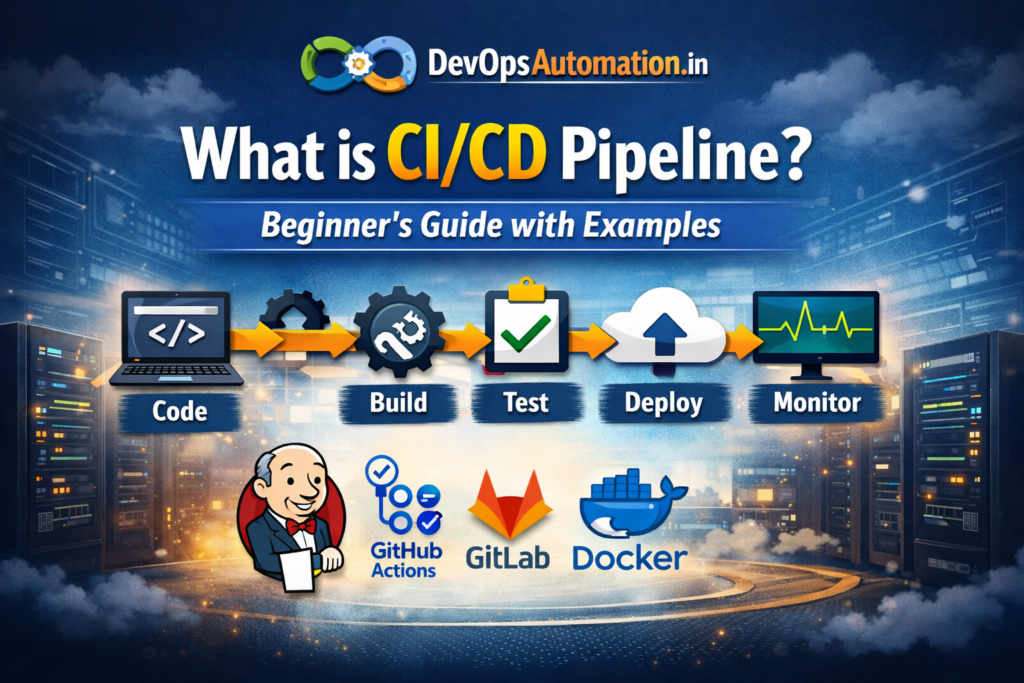
A CI/CD pipeline automates code integration, testing, and deployment so software can be released faster, more reliably, and with fewer human errors.
In today’s fast-moving software world, companies cannot afford slow releases, broken deployments, or manual mistakes. Whether it’s a startup shipping new features daily or an enterprise maintaining mission-critical systems, automation is the backbone of modern DevOps — and CI/CD makes that possible.
If you’re learning DevOps in 2026, CI/CD is not optional. It is a core skill every DevOps engineer must master.
In this beginner-friendly guide, you’ll learn:
? What CI/CD really means
? How a CI/CD pipeline works step by step
? Real-world pipeline examples
? Popular CI/CD tools
? Best practices and security tips
? Common beginner mistakes
? Career benefits of learning CI/CD
Let’s get started ?

? What Does CI/CD Mean?
CI/CD stands for:
? Continuous Integration (CI)
Continuous Integration means developers frequently push their code into a shared repository such as GitHub, GitLab, or Bitbucket.
Every time code is pushed:
?? Automated build starts
?? Unit tests run automatically
?? Code quality checks execute
?? Errors are detected early
This ensures that broken code never accumulates and problems are caught quickly rather than weeks later.
Example:
A developer commits a new feature. The CI pipeline automatically compiles the code and runs tests within minutes. If something fails, the developer gets instant feedback.
? Continuous Delivery (CD)
Continuous Delivery ensures that the application is always in a deployable state.
After CI succeeds:
?? Application is packaged
?? Artifacts are created
?? Deployment happens to staging
?? Manual approval may trigger production deployment
This approach allows teams to release whenever business is ready — safely and confidently.
? Continuous Deployment
In Continuous Deployment, even production releases happen automatically without manual approval.
If all tests pass successfully:
?? Code is deployed directly to production
?? Monitoring verifies health
?? Rollback happens automatically if issues occur
This is commonly used in high-maturity DevOps teams.
? Why CI/CD is Important in DevOps
CI/CD solves many real-world engineering problems.
? Faster Releases
Manual deployments can take hours or days. CI/CD reduces release time to minutes.
? Fewer Bugs
Automated testing catches bugs early before they reach customers.
? Reduced Manual Work
Repetitive tasks like builds, testing, and deployments are automated.
? High Reliability
Consistent automation removes human errors.
? Easy Rollbacks
If a release fails, pipelines can automatically revert to the previous stable version.
? Better Security
Security scanning and compliance checks run automatically.
Modern DevOps teams simply cannot operate efficiently without CI/CD pipelines.
? How a CI/CD Pipeline Works (Step-by-Step)
A CI/CD pipeline consists of multiple automated stages. Each stage validates code quality before moving forward.
Let’s walk through a typical pipeline:
1?? Code Commit
Developers write code locally and push it to a Git repository.
?? GitHub
?? GitLab
?? Bitbucket
Each commit automatically triggers the pipeline.
? If you’re new to Git, read: Git basics for DevOps beginners
2?? Build Stage
The pipeline compiles the code and prepares application artifacts.
Examples:
?? Java ? Maven / Gradle builds
?? Node.js ? npm build
?? Docker ? Image build
Artifacts may include:
- Binary files
- Docker images
- Packages
3?? Automated Testing
Testing ensures the application behaves correctly.
Common tests include:
?? Unit Tests
?? Integration Tests
?? UI Tests
?? Security Scans
?? Linting & Code Quality
If tests fail, the pipeline stops immediately.
4?? Artifact Storage
Successfully built artifacts are stored securely.
Popular artifact repositories:
?? Nexus
?? JFrog Artifactory
?? AWS S3
?? Docker Registry
Artifacts remain immutable and versioned.
5?? Deployment
The application is deployed automatically to environments:
?? Development
?? Staging
?? Production
Deployment strategies include:
- Blue-Green Deployment
- Rolling Updates
- Canary Releases
? Most environments run on Linux servers. Learn more: Linux fundamentals for DevOps engineers
6?? Monitoring & Feedback
After deployment, monitoring tools track:
?? Application uptime
?? Performance
?? Error rates
?? Resource usage
If something breaks, alerts notify engineers immediately.
?? Real-World CI/CD Pipeline Example
Let’s take a realistic example of a web application deployment pipeline.
Scenario
A company maintains an e-commerce website built using React and Node.js.
Step 1 – Developer Commit
A developer pushes code to GitHub.
Step 2 – Pipeline Trigger
GitHub Actions automatically triggers the pipeline.
Step 3 – Build
- npm install
- npm build
- Docker image created
Step 4 – Testing
- Unit tests executed
- Security vulnerability scan
- Code quality checks
Step 5 – Artifact Push
Docker image pushed to Docker Registry.
Step 6 – Deployment
- Kubernetes pulls the image
- New container starts
- Traffic shifts automatically
Step 7 – Monitoring
- Prometheus collects metrics
- Grafana dashboards visualize health
- Alerts configured
Within 5–10 minutes, the feature is live globally.
This is the power of CI/CD automation.
? CI/CD Pipeline Metrics: How Teams Measure Success
A CI/CD pipeline is not just about automation — it is also abou