What is Jenkins? Simple Beginner Guide to CI/CD Automation (2026)
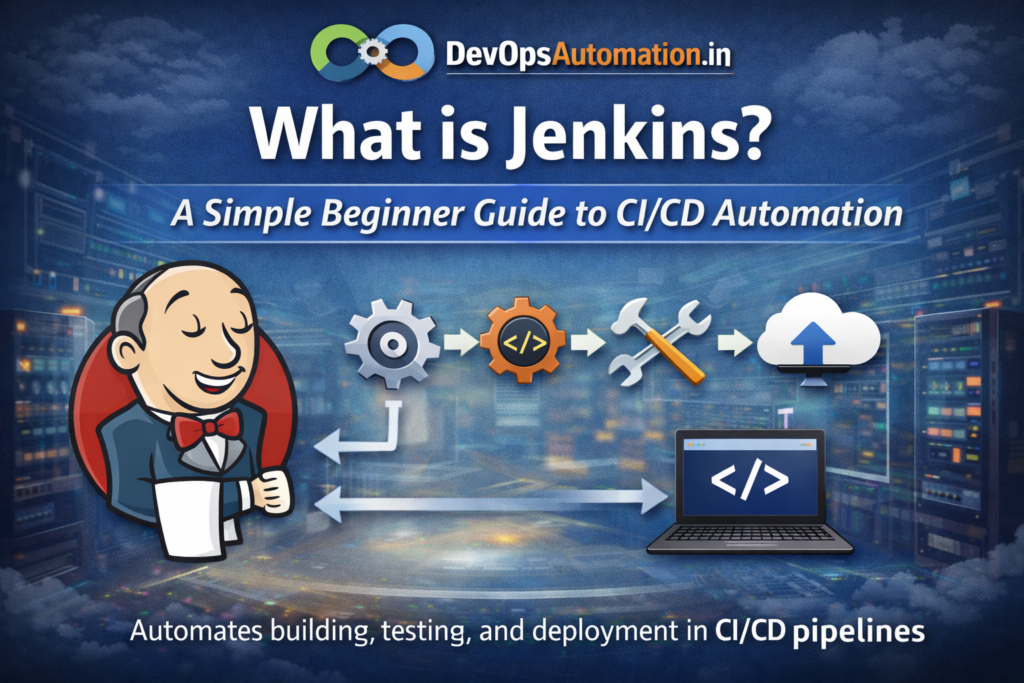
If you are starting your DevOps journey, one tool you will hear about again and again is Jenkins. Jenkins powers automation in thousands of companies worldwide and plays a major role in building fast, reliable CI/CD pipelines.
But beginners often ask:
- What is Jenkins exactly?
- Why do companies use Jenkins?
- How does Jenkins work behind the scenes?
- Is Jenkins difficult to learn?
This detailed guide answers all those questions in simple language.
By the end of this article, you will clearly understand:
- What Jenkins is and why it exists
- How Jenkins works step by step
- Jenkins architecture and components
- What a Jenkins pipeline is
- Real-world Jenkins example
- Benefits and limitations
- Best practices and security
- Career value of Jenkins
Many beginners search online asking what is Jenkins and how it fits into a DevOps CI/CD pipeline.
Let’s start from the basics.

? What is Jenkins?
What is Jenkins? Jenkins is an open-source automation server that helps teams automate the process of building, testing, and deploying applications. It is widely used to implement Continuous Integration (CI) and Continuous Delivery (CD) in DevOps environments.
Instead of manually compiling code, running tests, and deploying applications, Jenkins automatically performs these tasks whenever new code is pushed to a repository.
In simple terms:
Jenkins is a tool that automates software delivery workflows.
Jenkins monitors your source code repository (GitHub, GitLab, Bitbucket, etc.) and triggers automated jobs whenever a change happens.
This automation:
- Saves time
- Reduces human errors
- Improves consistency
- Speeds up software releases
Jenkins is written in Java and runs on Windows, Linux, and macOS.
? Why Jenkins is Important in DevOps
Modern software teams release features rapidly. Manual deployment cannot keep up with fast development cycles. Jenkins solves this problem by providing reliable automation.
Key reasons Jenkins is important:
? Faster Delivery
Automated pipelines run in minutes instead of hours or days.
? Early Bug Detection
Tests run automatically after every code change.
? Consistent Processes
The same steps execute every time, eliminating manual mistakes.
? Scalability
Multiple jobs can run in parallel using Jenkins agents.
? Improved Reliability
Failures are detected early before reaching production.
In DevOps culture, automation is mandatory — Jenkins is one of the best automation engines available.
?? How Jenkins Works – Simple Workflow
Let’s understand how Jenkins works using a basic flow.
- A developer pushes code to a Git repository
- Jenkins detects the code change automatically
- Jenkins pulls the latest code
- Build process starts
- Automated tests execute
- Artifacts are generated
- Application is deployed
All these steps happen without manual intervention.
? If you want deeper understanding, refer to your article:
How a CI/CD Pipeline Works – Step-by-Step Workflow
? Jenkins Architecture Explained
Understanding what is Jenkins at an architectural level helps engineers design scalable and secure automation platforms.
Jenkins follows a distributed architecture that allows scalability and flexibility.
?? Jenkins Controller (Master)
The controller manages:
- Job scheduling
- Build queue
- User interface
- Plugin management
- Security settings
It does NOT usually execute heavy build workloads.
??? Jenkins Agents (Nodes)
Agents execute build tasks. They can run on:
- Linux servers
- Cloud VMs
- Docker containers
Multiple agents allow parallel builds.
? Plugins
Jenkins has thousands of plugins that integrate with:
- GitHub
- Docker
- Kubernetes
- AWS
- Slack
- Jira
Plugins extend Jenkins functionality easily.
? Workspace
Each job gets a workspace directory where code is downloaded and built.
This architecture allows Jenkins to scale from small projects to enterprise pipelines.
? What is a Jenkins Job?
A Jenkins job defines what actions Jenkins should perform.
Examples:
- Pull code from Git
- Run Maven build
- Execute tests
- Deploy application
Types of Jenkins jobs:
- Freestyle job
- Pipeline job
- Multibranch pipeline
- Folder job
Pipeline jobs are most popular today.
? What is a Jenkins Pipeline?
A Jenkins pipeline is a set of automated steps written as code inside a file called Jenkinsfile.
Pipelines provide:
- Version control
- Reproducibility
- Visibility
- Scalability
Example Pipeline Stages
- Checkout
- Build
- Test
- Security Scan
- Deploy
Each stage executes sequentially or in parallel.
Example Jenkinsfile (Basic)
pipeline {
  agent any
  stages {
    stage('Build') {
      steps {
        echo 'Building application'
      }
    }
    stage('Test') {
      steps {
        echo 'Running tests'
      }
    }
    stage('Deploy') {
      steps {
        echo 'Deploying application'
      }
    }
  }
}
This file defines the entire automation logic.
? Real-World Jenkins Example
Let’s take a real scenario.
Scenario: Web Application Deployment
A team develops a Java web application.
Step 1 – Code Commit
Developer pushes code to GitHub.
Step 2 – Jenkins Trigger
Jenkins detects the change using webhook.
Step 3 – Build
Jenkins compiles the code using Maven.
Step 4 – Testing
JUnit tests execute automatically.
Step 5 – Docker Image
Docker image is created and tagged.
Step 6 – Deployment
Image is deployed to staging server.
Step 7 – Monitoring
Application health is monitored.
This entire pipeline runs automatically in minutes.
? Popular Tools Integrated with Jenkins
Jenkins integrates easily with many tools:
| Category | Tools |
|---|---|
| SCM | GitHub, GitLab, Bitbucket |
| Build | Maven, Gradle, NPM |
| Containers | Docker, Kubernetes |
| Cloud | AWS, Azure, GCP |
| Testing | Selenium, JUnit |
| Monitoring | Prometheus, Grafana |
This flexibility makes Jenkins extremely powerful.
? Jenkins vs Other CI/CD Tools
| Tool | Best For |
|---|---|
| Jenkins | Highly customizable pipelines |
| GitHub Actions | GitHub-native automation |
| GitLab CI | Built-in DevOps platform |
| CircleCI | Cloud-first pipelines |
| Azure DevOps | Microsoft ecosystem |
Jenkins is preferred when:
- Custom workflows are required
- Self-hosted control is needed
- Enterprise integrations are complex
? Benefits of Jenkins
- ? Free and open-source
- ? Massive plugin ecosystem
- ? Strong community support
- ? Platform independent
- ? Highly cust