AWS,Azure & GCP for DevOps: Simple & Complete Beginner Roadmap (2026)
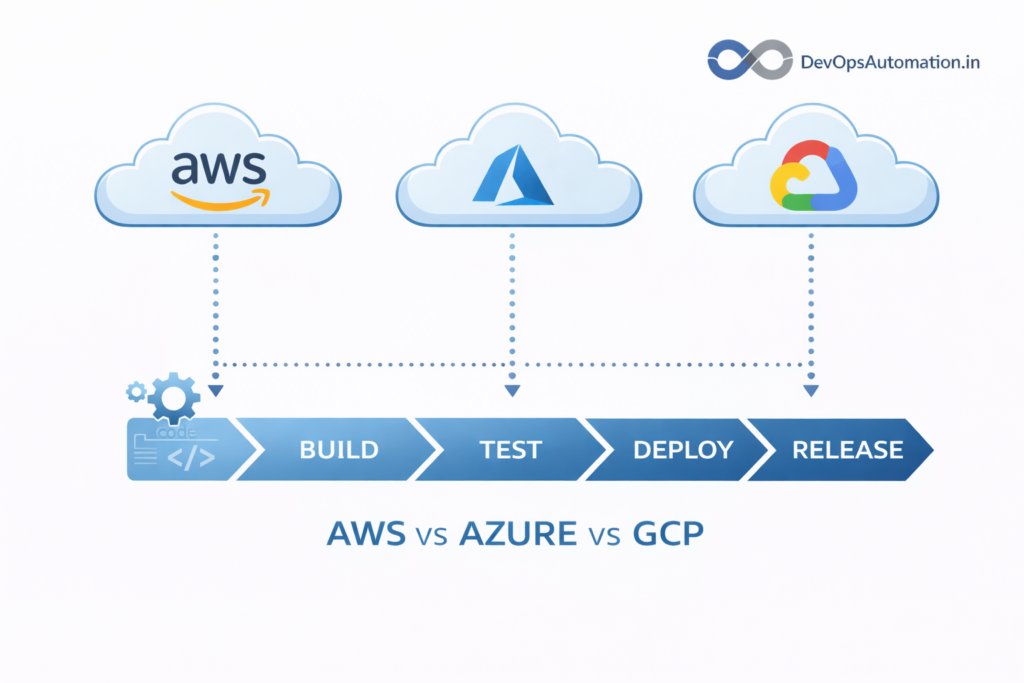
AWS Azure GCP for DevOps is the most practical cloud learning path for beginners who want to build real-world DevOps skills on modern cloud platforms.:
Which cloud platform should I learn — AWS, Azure, or Google Cloud (GCP)?
All three are powerful, widely used, and enterprise-grade. The good news is: once you learn one cloud platform properly, the skills transfer easily to the others. This roadmap will help you understand where to start, what to learn first, and how to build practical DevOps skills across AWS, Azure, and GCP.
In this guide, you’ll learn:
- Differences between AWS, Azure, and GCP
- Which cloud platform is best for DevOps beginners
- Core cloud services you must learn first
- A step-by-step DevOps learning roadmap for each cloud
- How cloud integrates with CI/CD, Docker, and Kubernetes
- A practical 90-day learning plan
- Career guidance and certifications

? AWS vs Azure vs GCP – High-Level Comparison
All three cloud providers offer similar core services (compute, storage, networking), but they differ in ecosystem, enterprise adoption, and tooling.
| Feature | AWS | Azure | GCP |
|---|---|---|---|
| Market share | Largest | Strong in enterprises | Strong in data & AI |
| Best for | Startups + enterprises | Microsoft ecosystem | Cloud-native workloads |
| DevOps tools | Strong CI/CD integrations | Native DevOps tools | Kubernetes leadership |
| Learning resources | Massive | Enterprise docs | Strong tutorials |
Recommendation for beginners:
Start with AWS due to wider adoption, then expand to Azure or GCP later.
? Why DevOps Engineers Must Learn Cloud Platforms
Modern DevOps pipelines run on the cloud. CI/CD servers, container platforms, monitoring systems, and production workloads are all cloud-hosted. Learning cloud platforms enables DevOps engineers to:
- Provision infrastructure on demand
- Automate deployments
- Scale applications
- Implement high availability
- Optimize costs
? Core Cloud Concepts to Learn First (Common Across All Clouds)
Before diving into any specific cloud provider, understand these core concepts:
- Compute (virtual machines, instances)
- Storage (object, block storage)
- Networking (VPCs, subnets, firewalls)
- Identity & Access Management (IAM)
- Monitoring & logging
- Billing & cost management
? AWS for DevOps – Beginner Roadmap
Step 1: AWS Basics
- What is AWS?
- Regions and availability zones
- Free tier usage
Step 2: Core AWS Services
- EC2 (compute)
- S3 (storage)
- VPC (networking)
- IAM (access control)
Step 3: AWS + CI/CD
- Host Jenkins on EC2
- Store artifacts in S3
- Deploy applications
Step 4: Containers & Kubernetes on AWS
- Docker on EC2
- Kubernetes basics
? Azure for DevOps – Beginner Roadmap
Azure is widely used in enterprises using Microsoft technologies.
Step 1: Azure Basics
- Azure portal
- Resource groups
- Subscriptions
Step 2: Core Azure Services
- Virtual Machines
- Blob Storage
- Virtual Networks
- Azure Active Directory
Step 3: Azure DevOps
- Pipelines
- Repos
- Boards
Step 4: Containers on Azure
- Container services
- Kubernetes concepts
? GCP for DevOps – Beginner Roadmap
Google Cloud is known for cloud-native technologies and Kubernetes leadership.
Step 1: GCP Basics
- Projects and billing
- Cloud Console
Step 2: Core GCP Services
- Compute services
- Cloud Storage
- Networking
- IAM
Step 3: CI/CD on GCP
- Hosting CI tools
- Automated deployments
Step 4: Kubernetes Ecosystem
- Kubernetes fundamentals
- Cloud-native DevOps practices
? Cloud + CI/CD + Containers + Kubernetes
A modern DevOps workflow looks like this:
- Code pushed to Git
- CI/CD pipeline builds & tests
- Container images created
- Images deployed to cloud
- Kubernetes manages scaling
- Monitoring & logging
? 90-Day Cloud Learning Plan for DevOps Beginners
Days 1–30:
- Cloud basics + AWS fundamentals
- Launch VMs
- Configure IAM
Days 31–60:
- Integrate Jenkins with cloud
- Deploy sample apps
- Learn basic networking
Days 61–90:
- Docker on cloud
- Kubernetes basics
- Monitoring & cost optimization
? Cloud-Native DevOps Architecture on AWS, Azure & GCP
Modern DevOps practices rely heavily on cloud-native architecture. Whether you work on AWS, Azure, or GCP, the underlying design principles remain the same: build scalable, resilient, and automated systems. Cloud-native architecture emphasizes loosely coupled services, automation-first infrastructure, and observability by design.
On AWS, cloud-native DevOps often uses virtual machines, managed databases, and scalable load balancers to run applications. Azure provides similar capabilities through its compute and networking services, making it easier for teams using Microsoft tools to adopt DevOps practices. GCP, with its strong background in containerized workloads, is widely used for building microservices and cloud-native platforms.
Learning AWS Azure GCP for DevOps means understanding how cloud-native patterns translate across platforms. Concepts like immutable infrastructure, stateless services, and infrastructure as code are portable skills that apply to all three clouds.
? Real-World DevOps Workflow Using AWS, Azure, and GCP
A typical real-world DevOps workflow looks similar regardless of the cloud provider:
- Developers push code to a Git repository
- CI/CD pipelines build and test applications
- Container images are created
- Images are deployed to cloud environments
- Applications are monitored in production
On AWS, DevOps teams often host CI servers on virtual machines and deploy applications to cloud compute services. Azure DevOps pipelines integrate naturally with Azure cloud services for automated deployments. GCP integrates well with container orchestration platforms, making it popular for microservices-based architectures.
Understanding AWS Azure GCP for DevOps enables teams to design portable workflows that work across multi-cloud environments.
? Monitoring, Logging, and Observability Across Clouds
Monitoring and observability are critical aspects of DevOps. All three cloud platforms provide built-in tools for collecting metrics, logs, and traces. These tools help teams monitor application health, detect anomalies, and troubleshoot issues quickly.
In cloud environments, centralized logging is essential because applications run across multiple instances and regions. Observability practices allow DevOps teams to understand system behavior under load and optimize performance. Learning these practices as part of AWS Azure GCP for DevOps ensures you can operate production systems reliably.
?? Infrastructure as Code in Multi-Cloud DevOps
Infrastructure as Code (IaC) allows DevOps engineers to define cloud infrastructure using configuration files. This approach ensures consistent environments across AWS, Azure, and GCP. IaC improves automation, repeatability, and disaster recovery.
By learning IaC concepts as part of AWS Azure GCP for DevOps, beginners gain the ability to manage infrastructure at scale. This skill is essential for building reproducible DevOps pipelines and reducing manual configuration errors.
? Security and Identity Management in Multi-Cloud DevOps
Security is a shared responsibility between cloud providers and users. Identity and access management (IAM) ensures that only authorized users and services can access cloud resources. DevOps teams must design secure access controls, manage secrets, and monitor security events.
Learning security best practices across AWS, Azure, and GCP is a crucial part of AWS Azure GCP for DevOps. Strong security foundations prevent misconfigurations and reduce the risk of data breaches in cloud environments.