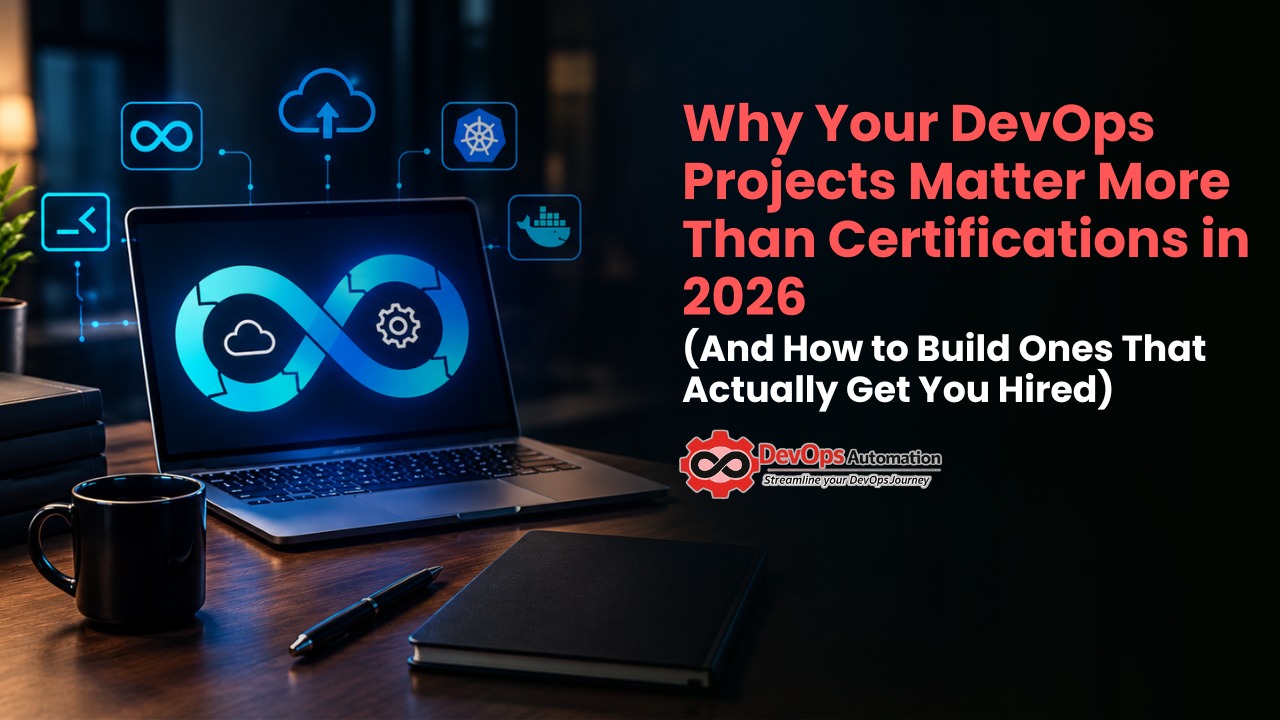
Why Your DevOps Projects Matter More Than Certifications in 2026 (And How to Build Ones That Actually Get You Hired)
Certifications look good on
LinkedIn. They give you confidence. They prove you can pass an exam.
But when hiring managers open your
profile in 2026, they rarely stop at the badges. They scroll straight to your
GitHub. They want to see what you have actually built, broken, fixed, and
shipped.
If you are still collecting
certificates without a strong project portfolio, you are playing the old game.
The new game rewards engineers who can show real automation systems. For a
structured way to build those systems step by step, check out our DevOps Full Course Tutorial: A Practical Path with Real Projects.
This post explains why projects now
outweigh certifications and exactly how to create ones that make recruiters
stop scrolling.
The Reality Check: What Hiring Managers Actually
Care About
In 2026, most mid-to-senior DevOps
roles expect you to demonstrate:
●
You can design and troubleshoot
CI/CD pipelines
●
You understand containers and
orchestration beyond basic tutorials
●
You treat infrastructure as code,
not click-ops
●
You can observe systems and respond
to failures
●
You document decisions and failures
clearly
A certification shows you studied. A
well-built project shows you can deliver.
Certification vs Project: A Clear Comparison
|
Aspect |
Certification
Advantage |
Strong
Project Advantage |
|
Signal to recruiters |
“I studied this topic” |
“I can build and operate this” |
|
Interview depth |
Surface-level questions |
Deep technical + scenario-based
discussion |
|
Differentiation |
Easy to match with many candidates |
Hard to fake, unique to you |
|
Learning retention |
Often fades after exam |
Stays because you solved real
problems |
|
Long-term career value |
Good for entry filters |
Builds actual skill and confidence |
|
Time investment ROI |
High short-term, limited long-term |
Compounding returns as you improve
the project |
Certifications still help you clear
initial screening filters, especially for freshers. But the candidates who
convert interviews into offers almost always have tangible work to discuss.
What Makes a DevOps Project Stand Out in 2026
Avoid the classic “todo app with
Docker” trap. Hiring managers have seen hundreds of those. Aim for projects
that show end-to-end thinking.
Strong project characteristics:
●
Solves a realistic problem (not just
a tool demo)
●
Includes CI/CD, containers, and at
least basic infrastructure as code
●
Has monitoring or logging
●
Contains clear documentation (README
+ architecture decisions)
●
Shows iteration (you improved it
over time)
●
Is publicly available on GitHub with
meaningful commit history
5 Project Ideas That Actually Impress
1. Full CI/CD Pipeline for a
Microservices App
Build a small multi-service
application. Automate testing, building Docker images, pushing to a registry,
and deploying to Kubernetes (or even a simple Docker Swarm / Compose setup on a
cloud VM). Add staging and production environments with approval gates.
2. Infrastructure as Code + GitOps
Setup
Use Terraform to provision cloud
resources (VPC, compute, database). Manage application deployments with Argo CD
or Flux. Show how a Git commit triggers infrastructure and application changes
safely.
3. Observability Stack for a Running
Application
Deploy an app, then add Prometheus,
Grafana, and alerting rules. Create useful dashboards and document how you
would diagnose common failures (high latency, memory leaks, error spikes).
4. Cost-Optimized & Secure
Pipeline
Take a basic pipeline and improve
it: multi-stage Docker builds, image scanning, least-privilege IAM roles,
secret management, and cost visibility. This shows senior-level thinking.
5. Self-Service Developer Platform
(Advanced)
Create a simple internal developer
platform where a developer can request an environment via a form or CLI, and
automation handles provisioning, deployment, and teardown. Even a basic version
signals strong systems thinking.
How to Build and Present Your Projects
Effectively
- Start
small and improve iteratively - Version 1 does not need to
be perfect.
- Document
ruthlessly - Explain architecture,
trade-offs, failures, and how you fixed them.
- Use
real tools that companies use - GitHub Actions, Terraform,
Kubernetes, Prometheus, etc.
- Make
the repository clean - Good README, clear folder
structure, meaningful commits.
- Link
everything on your resume and LinkedIn -One
strong project is better than five weak ones.
- Be ready to discuss it deeply
- Interviewers will ask “Why did you choose this approach?” and “What broke?”
Common Portfolio Mistakes to Avoid
- Copy-pasting
tutorials without understanding or customising
- No
monitoring or failure-handling story
- Empty
or sparse commit history
- No
documentation of decisions
- Projects
that only work on your laptop
- Listing 15 tools without
showing them working together
Final Thought
In 2026, the engineers who get hired
fastest are not the ones with the longest list of certifications. They are the
ones who can open a GitHub repository and walk an interviewer through a real
system they designed, automated, observed, and improved.
Build projects that prove you can
deliver. Treat certifications as supporting evidence, not the main story. When
you are ready to map the full skill path that supports these projects, follow
our complete DevOps Roadmap 2026 – Step-by-Step Guide from Beginner to Pro.
Your next offer will come from what
you can show, not just what you can claim.
Frequently Asked Questions (FAQs)
1. How many projects do I need in my
DevOps portfolio?
Quality beats quantity. Two or three
well-documented, end-to-end projects are far more effective than eight shallow
ones.
2. Should I still get certifications
if projects matter more?
Yes, especially early in your
career. Certifications help you pass automated screening. Just do not stop
there pair them with real work.
3. Can I use free-tier cloud
accounts for portfolio projects?
Absolutely. AWS Free Tier, Oracle
Cloud Free Tier, and similar offerings are perfect for building realistic
projects without high costs.
4. What if my project is not
perfect?
That is actually a strength.
Documenting problems you faced and how you solved them shows maturity and real
engineering thinking.
5. How public should my projects be?
Fully public is best. Private
repositories hide the evidence that hiring managers want to see.
6. Is contributing to open source
better than personal projects?
Both help. Personal projects give
you full control and a clear story. Open-source contributions show
collaboration. Ideally do some of each.
About the Author
DevOps Team @ DevOps Automation
We are practising engineers and
trainers focused on helping people build real skills, not just collect tools or
certificates. Our content emphasises practical projects, clear learning
sequences, and career outcomes so you can move from learning to shipping with
confidence.