DevOps Roadmap 2026 – Step-by-Step Guide from Beginner to Pro
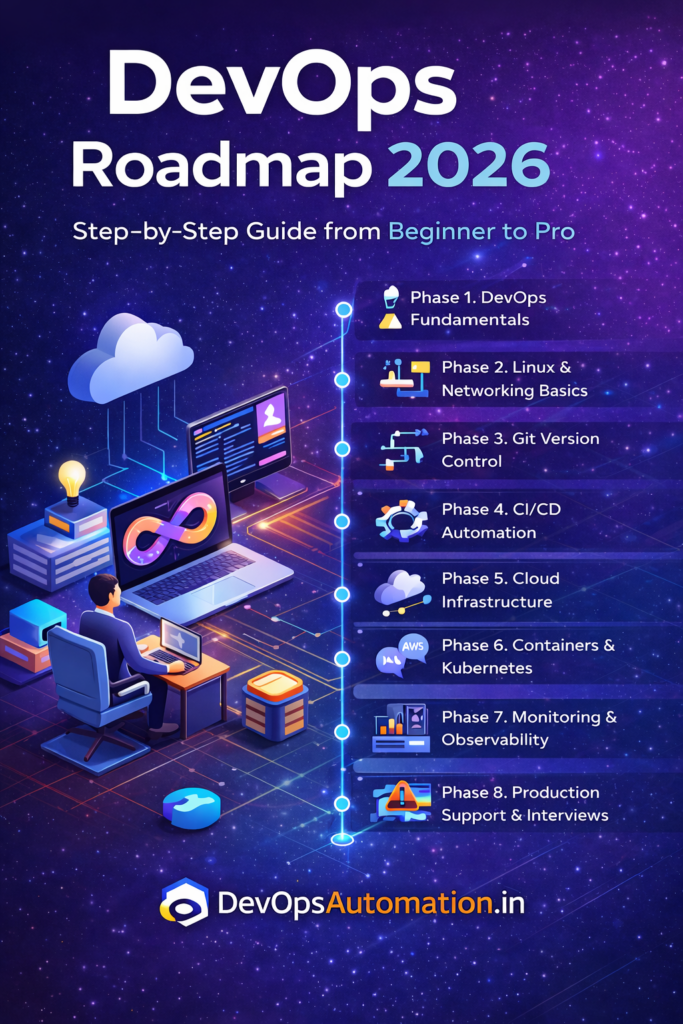
DevOps Roadmap 2026 is a complete step-by-step learning path designed to take beginners from fundamentals to job-ready DevOps skills.
? Welcome to DevOpsAutomation.in
DevOpsAutomation.in is a practical learning platform designed to help you become a job-ready DevOps Engineer in 2026.
This website follows a clear, phase-based DevOps roadmap, starting from absolute basics and progressing all the way to production support and DevOps interviews.
Whether you are:
- A beginner starting from zero
- A developer moving into DevOps
- An operations engineer upskilling
- Or someone preparing for DevOps interviews
? This roadmap is built for you.

? What is DevOps?
DevOps is a culture and set of practices that combines Development (Dev) and Operations (Ops) to deliver software faster, more reliably, and at scale.
DevOps focuses on:
- Automation
- Continuous delivery
- Collaboration
- Monitoring & reliability
- Faster feedback loops
In 2026, DevOps engineers are expected to have hands-on skills, not just theoretical knowledge.
Real-World Example of DevOps in Action
Imagine a developer pushes new code to a Git repository. Instead of waiting for a manual deployment, a CI/CD pipeline automatically runs tests, builds the application, creates a container image, and deploys it to production. Monitoring tools immediately start tracking performance and health. If something fails, alerts notify the team within minutes.
This automated flow reduces human errors, speeds up releases, and improves system reliability. This is how modern engineering teams operate in real production environments today.
DevOps engineers are responsible for designing and maintaining these automation pipelines, ensuring systems stay secure, scalable, and stable.
? Why Follow This DevOps Roadmap 2026?
Most DevOps learners fail because:
- They learn tools randomly
- They skip fundamentals
- They lack real-world context
This roadmap solves that problem by:
? Teaching concepts in the right order
? Focusing on real production skills
? Aligning with industry expectations
? Preparing you for DevOps interviews
? DevOps Roadmap 2026 – Phase-by-Phase Learning Path
DevOps Roadmap 2026 – Phase-by-Phase Learning Path
? Phase 1: DevOps Fundamentals
Goal: Build a strong DevOps foundation.
You will learn:
- What DevOps is and why it exists
- DevOps lifecycle and culture
- Agile vs DevOps
- CI/CD basics
- DevOps roles and responsibilities
? This phase ensures you understand the “why” before the “how”.
? Read: Phase 1 – DevOps Fundamentals
? Phase 2: Linux & Networking Basics for DevOps
Goal: Master the environment where DevOps works.
You will learn:
- Linux commands and file system
- Process management
- Networking basics (DNS, ports, TCP/IP)
- Troubleshooting connectivity issues
- Shell basics for automation
? Linux and networking are mandatory skills for every DevOps engineer.
Practical Linux Skills You Should Practice
Here are some real commands every DevOps engineer uses in production:
df -h
Check disk usage when servers run out of space.
top
Monitor CPU and memory usage during performance issues.
ss -tulpn
Identify which services are running on which ports.
tail -f /var/log/syslog
Track logs in real time during troubleshooting.
You should practice installing packages, managing services, editing configuration files, and analyzing logs on a Linux VM.
Mini Project Idea
Create a Linux virtual machine, install Nginx, expose it on a custom port, configure firewall rules, and troubleshoot access issues.
? Read: Phase 2 – Linux & Networking Basics for DevOps
? Phase 3: Git Version Control for DevOps
Goal: Learn how teams manage code collaboratively.
You will learn:
- Git fundamentals
- Branching strategies
- Pull requests and code reviews
- GitHub / GitLab workflows
- Version control best practices
? Every DevOps pipeline starts with Git.
Real Git Workflow Example
A typical DevOps workflow looks like this:
- Create a feature branch from main.
- Make changes and commit frequently.
- Push code to remote repository.
- Open a pull request.
- Run automated CI checks.
- Review and merge into main branch.
You should practice resolving merge conflicts and maintaining clean commit history.
Mini Project Idea
Create a sample repository on GitHub, simulate team collaboration using branches, pull requests, and tags.
? Read: Phase 3 – Git Version Control for DevOps
? Phase 4: CI/CD Automation Explained
Goal: Automate build, test, and deployment workflows.
You will learn:
- CI/CD concepts
- Jenkins pipelines
- GitHub Actions workflows
- Build, test, and deploy automation
- Real-world CI/CD use cases
? CI/CD automation is the heart of DevOps.
Example CI/CD Pipeline Flow
A simple pipeline usually includes:
- Code checkout
- Build stage
- Unit testing
- Security scanning
- Docker image build
- Deployment
Example Jenkins pipeline logic:
Build ? Test ? Package ? Deploy ? Monitor
Failures should stop the pipeline automatically and notify the team.
Mini Project Idea
Create a Jenkins or GitHub Actions pipeline that deploys a simple application automatically on every commit.
? Read: Phase 4 – CI/CD Automation Explained
? Phase 5: Cloud Infrastructure for DevOps
Goal: Learn where modern applications run.
You will learn:
- Cloud fundamentals (AWS, Azure, GCP)
- Compute, storage, and networking
- IAM and security basics
- Cloud deployment patterns
- CI/CD integration with cloud
? Cloud knowledge is mandatory for DevOps roles in 2026.
? Read: Phase 5 – Cloud Infrastructure for DevOps
? Phase 6: Containers & Kubernetes Basics
Goal: Package and run applications at scale.
You will learn:
- Docker fundamentals
- Container images and registries
- Kubernetes architecture
- Pods, services, and deployments
- Kubernetes CI/CD integration
? Kubernetes is a must-have DevOps skill.
Practical Kubernetes Concepts
Important objects you must understand:
- Pods – smallest deployable unit
- Deployments – manage replicas and updates
- Services – expose applications
- ConfigMaps – externalize configuration
Example command:
kubectl get pods
This command is used daily to monitor cluster health.
Mini Project Idea
Deploy a sample web application on Kubernetes and expose it using a service.
? Read: Phase 6 – Containers & Kubernetes Basics
? Phase 7: Monitoring & Observability in DevOps
Goal: Ensure system reliability and performance.
You will learn:
- Monitoring vs observability
- Metrics, logs, and traces
- Prometheus and Grafana
- ELK stack
- Alerting and incident response
? DevOps engineers are responsible for uptime and reliability.
? Read: Phase 7 – Monitoring & Observability in DevOps
? Phase 8: Production Support & DevOps Interview Preparation
Goal: Become job-ready and production-ready.
You will learn:
- Production incident handling
- On-call practices
- Troubleshooting real issues
- Root cause analysis (RCA)
- DevOps interview questions and scenarios
? This phase prepares you for real DevOps jobs.
? Read: Phase 8 – Production Support & DevOps Interview Preparation
?? How Long Does It Take to Learn DevOps?
The time required to become job-ready in DevOps depends on your background, consistency, and how much hands-on practice you do.
Here is a realistic estimate based on common learning paths:
- Beginners with no IT background: 9–12 months
- Developers or SysAdmins: 4–6 months
- IT graduates with basic Linux knowledge: 3–5 months
DevOps is not something you master in a few weeks. It requires building muscle memory through real projects, troubleshooting failures, and understanding how systems behave under load.
The key is not speed — it’s consistency. Even one hour of focused practice daily can create strong long-term results.
?? Common Mistakes DevOps Beginners Make
Many learners struggle not because DevOps is hard, but because they approach it incorrectly.
Here are some common mistakes you should avoid:
- Jumping directly into Kubernetes or Cloud without understanding Linux and networking.
- Memorizing commands instead of understanding