Pull Requests, Code Reviews & GitOps Practices for DevOps (Production Guide)
Pull Requests, Code Reviews & GitOps Practices for DevOps
Pull Requests, Code Reviews & GitOps Practices for DevOps are essential skills every DevOps engineer must master to work safely in production environments.
In modern DevOps teams, no code reaches production directly. Every change flows through:
- Pull requests
- Automated CI checks
- Code reviews
- GitOps-based deployments
This article explains how pull requests, code reviews, and GitOps practices for DevOps work together to ensure reliability, security, and auditability.
Pull Requests & Code Reviews for DevOps are essential practices that improve code quality, collaboration, and GitOps automation.

Why Pull Requests Matter in DevOps
In DevOps, a pull request (PR) is not just a Git feature — it is a control gate.
Pull requests help teams:
- Prevent broken code from reaching production
- Trigger CI/CD pipelines automatically
- Enforce review and approval policies
- Maintain a clean and auditable Git history
Without pull requests, DevOps teams risk:
- Accidental production outages
- Unreviewed infrastructure changes
- Security misconfigurations
That’s why pull requests for DevOps are mandatory in real-world environments.
What Is a Pull Request?
A pull request is a request to merge code from one branch into another, usually:
feature/*?developdevelop?main
In DevOps workflows, pull requests:
- Trigger automated builds and tests
- Block merging if checks fail
- Require approval from reviewers
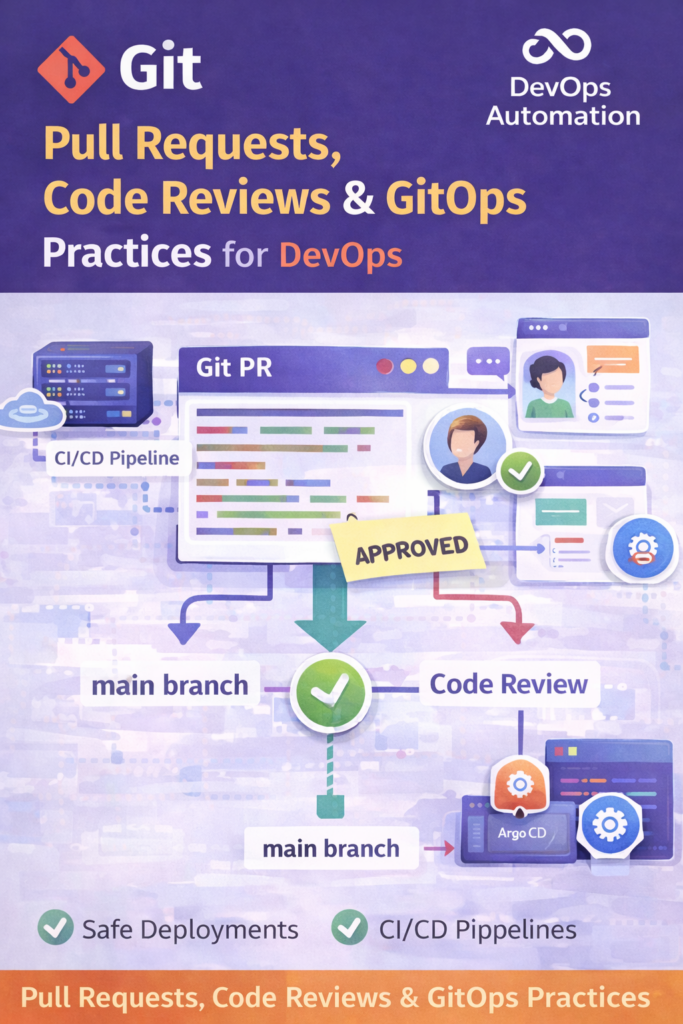
Typical Pull Request Flow
- Developer pushes code to a feature branch
- Pull request is created
- CI pipeline runs automatically
- Code review happens
- PR is approved and merged
This process is central to pull requests and code reviews for DevOps.
Code Reviews in DevOps (Beyond Syntax)
Code reviews in DevOps are not only about code quality.
Reviewers check:
- Infrastructure changes (IaC)
- Security implications
- Performance impact
- Rollback safety
- Monitoring and alerting coverage
A good DevOps code review answers:
- Will this break production?
- Is this observable?
- Can we roll this back safely?
This makes code reviews for DevOps far more critical than in traditional development.
Best Practices for Code Reviews in DevOps
To keep reviews effective:
- Keep pull requests small
- Review logic, not formatting
- Ask “what happens if this fails?”
- Ensure CI checks pass before approval
- Never approve without understanding the change
Strong code reviews reduce incidents and improve team confidence.
CI/CD Pipelines Triggered by Pull Requests
In DevOps, pull requests are tightly integrated with CI/CD.
Common checks triggered by PRs:
- Unit tests
- Linting
- Security scans
- Terraform plan checks
- Kubernetes manifest validation
If any check fails:
- The pull request is blocked
- Code cannot be merged
This automation makes pull requests in DevOps safe and predictable.
Introduction to GitOps Practices
GitOps is an operational model where Git is the single source of truth for:
- Application configuration
- Infrastructure state
- Kubernetes deployments
In GitOps:
- You don’t deploy manually
- You change Git
- Systems sync automatically
GitOps practices for DevOps bring:
- Auditability
- Reproducibility
- Faster recovery
How GitOps Works in Real DevOps Teams
A typical GitOps workflow:
- Engineer creates a pull request
- Configuration change is reviewed
- PR is merged into
main - GitOps tool detects the change
- Production environment syncs automatically
No SSH. No manual commands.
Everything flows through Git.
This is why GitOps practices for DevOps are now industry standard.
Pull Requests + GitOps = Production Safety
When combined:
- Pull requests control what changes
- Code reviews validate how changes work
- GitOps controls how changes reach production
This trio:
- Reduces human error
- Improves compliance
- Makes rollbacks trivial
Common Beginner Mistakes
? Merging without review
? Large pull requests
? Skipping CI failures
? Direct production changes
? Not treating Git as source of truth
Avoiding these mistakes separates junior DevOps engineers from production-ready DevOps engineers.
How This Fits Into the DevOps Roadmap
This skill connects directly to:
- Git branching & merging
- CI/CD automation
- Infrastructure as Code
- Kubernetes deployments
- Production support
Mastering pull requests, code reviews, and GitOps practices for DevOps makes you job-ready.
What You’ll Learn Next
? Next Git Skill:
Git Rebase vs Merge (When & Why in Production)
This is one of the most asked DevOps interview topics.
Key Takeaways
- Pull requests protect production
- Code reviews enforce reliability
- GitOps automates deployments
- Git becomes the control plane
- DevOps maturity starts with Git discipline
? Internal & External Links
Internal Links
External