Phase 8: Production Support & DevOps Interview Preparation (Complete Guide)
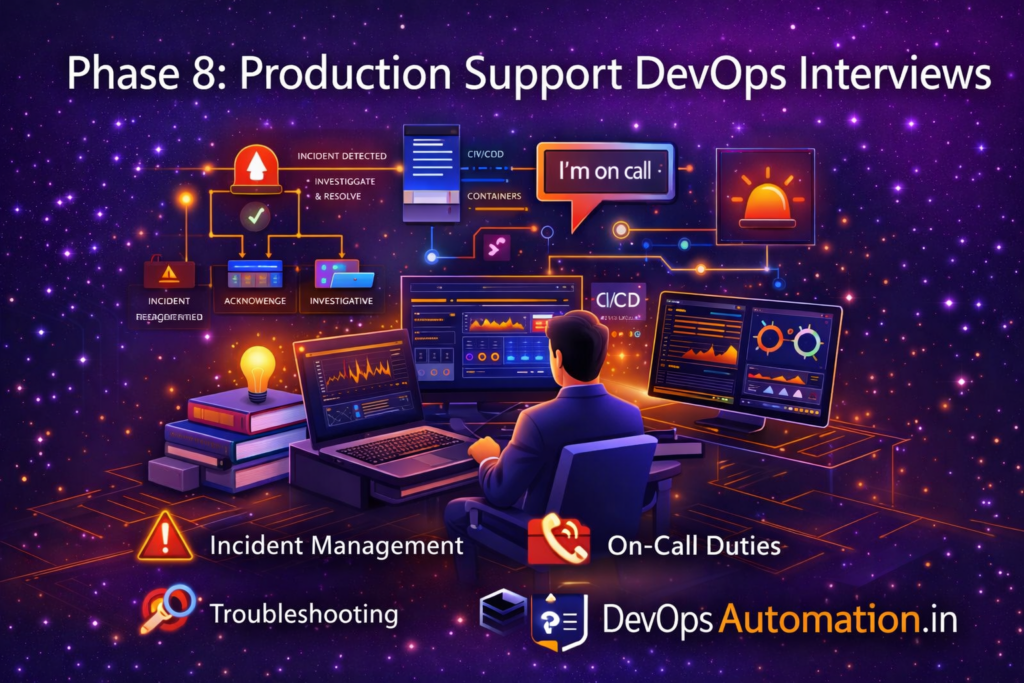
? Production Support & DevOps Interviews
Production Support & DevOps Interviews is the final and most practical phase of the DevOps Roadmap 2026.
After learning automation, cloud, containers, and monitoring, DevOps engineers must be able to support live production systems and confidently handle real-world DevOps interviews.
Production Support & DevOps Interviews focuses on operational maturity, ownership, responsibility, and readiness for real DevOps roles in production environments.

What Is Production Support in DevOps?
Production support in DevOps refers to maintaining, monitoring, and troubleshooting live systems that real users depend on every day.
Production systems require:
- High availability
- Fast incident response
- Clear communication
- Continuous improvement
In DevOps, production support is a shared responsibility across teams rather than a separate support function.
Key Responsibilities in Production Support
DevOps engineers involved in production support handle responsibilities such as:
- Monitoring system health
- Responding to alerts
- Investigating incidents
- Fixing deployment issues
- Scaling infrastructure
- Performing root cause analysis
Mastering these responsibilities is essential for Production Support & DevOps Interviews and real DevOps roles.
Incident Management Process
Incident management is a structured approach to handling production issues efficiently.
A typical incident lifecycle includes:
- Incident detection (alerts or user reports)
- Incident acknowledgment
- Investigation and mitigation
- Root cause analysis
- Post-incident review
A calm, systematic approach during incidents is a key skill evaluated in Production Support & DevOps Interviews.
On-Call Responsibilities in DevOps
Most DevOps roles include on-call rotations to ensure production stability.
On-call engineers are responsible for:
- Responding to alerts quickly
- Assessing incident severity
- Taking immediate corrective actions
- Communicating status updates to stakeholders
Understanding on-call responsibilities is a common topic in Production Support & DevOps Interviews.
Troubleshooting in Production Environments
Effective troubleshooting in production environments requires:
- Clear understanding of system architecture
- Use of logs, metrics, and traces
- Ability to isolate issues quickly
- Knowledge of rollback and recovery procedures
Strong troubleshooting skills differentiate junior engineers from senior DevOps professionals.
Change and Release Management
Production stability depends on controlled and well-planned changes.
DevOps teams rely on:
- Change management processes
- Release approvals
- Rollback strategies
- Blue-green or canary deployments
Interviewers frequently ask how candidates manage risk during production releases.
DevOps Best Practices for Production Systems
Some essential DevOps best practices for production systems include:
- Infrastructure as Code
- Automated deployments
- Monitoring and alerting
- Regular backups
- Security hardening
- Clear documentation and runbooks
These practices reduce downtime and improve system reliability.
Production Support & DevOps Interviews – Common Questions
Production Support DevOps Interviews is essential for production readiness and DevOps career growth.
Interviewers assess both technical expertise and mindset.
Common interview questions include:
- How do you handle production incidents?
- How do you troubleshoot high CPU or memory usage?
- What steps do you take during outages?
- How do you prevent recurring incidents?
- How do you balance speed and stability?
Preparing answers using real-world examples is critical for Production Support & DevOps Interviews.
Behavioral and Scenario-Based Interviews
Modern DevOps interviews focus heavily on scenario-based questions.
You may be asked to:
- Describe a production incident you handled
- Explain how you communicated during an outage
- Discuss a failure and what you learned from it
Clear communication and structured problem-solving matter as much as technical knowledge.
How Phase 8 Completes the DevOps Roadmap 2026
Production Support & DevOps Interviews ties together everything learned in previous phases:
- CI/CD Automation
- Cloud Infrastructure
- Containers & Kubernetes
- Monitoring & Observability
This phase transforms learners into job-ready DevOps professionals.
Final Tips for DevOps Interviews
- Focus on fundamentals, not just tools
- Explain your thought process clearly
- Use real-world examples
- Admit limitations honestly
- Demonstrate ownership and accountability
Interviewers value reliability and maturity as much as technical skills.
Phase 8 Summary
| Area | Covered |
|---|---|
| Production Support | ? |
| Incident Management | ? |
| On-Call Responsibilities | ? |
| Troubleshooting | ? |
| DevOps Interviews | ? |
? Internal & External Links
Internal Links
- Previous: Phase 7 – Monitoring & Observability in DevOps
- Roadmap: DevOps Roadmap 2026
- Phase 1 – DevOps Fundamentals
External (DOFOLLOW)