Phase 1: DevOps Fundamentals 2026 – Complete Beginner Guide
? DevOps Fundamentals 2026
DevOps Fundamentals 2026 is the first and most important step in your DevOps journey. Before learning tools like Docker, Kubernetes, or cloud platforms, you must clearly understand what DevOps is, why it exists, and how it works in real-world software teams.
This phase builds the foundation for all future DevOps learning.
What is DevOps?
DevOps is a combination of Development (Dev) and Operations (Ops). It is a culture, mindset, and set of practices that helps teams build, test, deploy, and operate software faster and more reliably.
Instead of working in silos, DevOps encourages:
- Collaboration between teams
- Automation of repetitive tasks
- Faster feedback loops
- Continuous improvement
In 2026, DevOps is no longer optional — it is a core requirement for modern software delivery.
Why DevOps Was Introduced
Before DevOps:
- Developers wrote code
- Operations teams deployed and managed servers
- Communication gaps caused delays
- Releases were slow and risky
DevOps was introduced to solve:
- Slow deployments
- Frequent failures
- Manual processes
- Lack of ownership
? DevOps bridges the gap between development and operations.
DevOps Fundamentals 2026 – Core Principles
Understanding these principles is critical:
? Collaboration
DevOps removes silos and promotes shared responsibility.
? Automation
Automate builds, tests, deployments, and infrastructure.
? Continuous Delivery
Deliver small, frequent changes instead of big risky releases.
? Monitoring & Feedback
Measure system performance and user experience continuously.
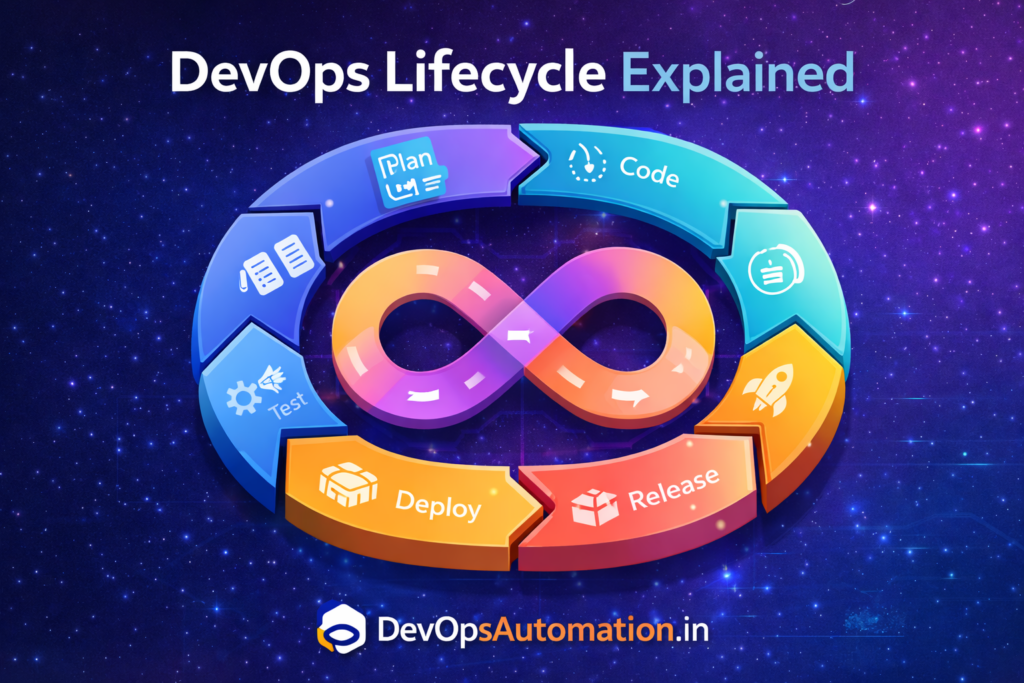
DevOps Lifecycle Explained
The DevOps lifecycle is a continuous loop:
- Plan – Define requirements and roadmap
- Code – Develop features and fixes
- Build – Compile and package applications
- Test – Automated testing for quality
- Release – Prepare for deployment
- Deploy – Push changes to production
- Operate – Run and manage applications
- Monitor – Track performance and reliability
? This cycle repeats continuously for faster innovation.

DevOps Culture vs DevOps Tools
A common beginner mistake is focusing only on tools.
? DevOps is NOT:
- Just Jenkins
- Just Docker
- Just Kubernetes
? DevOps IS:
- Culture + processes + tools
- Collaboration + automation
- Shared ownership
Tools support DevOps, but culture enables it.
Common DevOps Tools (High-Level Overview)
At the fundamentals stage, you should only know what tools exist, not master them yet.
- Version Control: Git, GitHub
- CI/CD: Jenkins, GitHub Actions
- Cloud: AWS, Azure, GCP
- Containers: Docker, Kubernetes
- Monitoring: Prometheus, Grafana
? You will learn these tools step by step in later phases.
Benefits of DevOps
Organizations adopt DevOps to achieve:
- ? Faster software delivery
- ? Reliable deployments
- ? Reduced failure rates
- ? Better automation
- ? Improved system stability
This is why DevOps roles are in high demand in 2026.
DevOps Roles & Responsibilities
Common DevOps-related roles:
- DevOps Engineer
- Site Reliability Engineer (SRE)
- Platform Engineer
- Cloud Engineer
Responsibilities typically include:
- CI/CD pipeline management
- Cloud infrastructure
- Monitoring and alerting
- Incident handling
- Automation and optimization
Who Should Learn DevOps Fundamentals 2026?
This phase is ideal for:
- Beginners with no DevOps experience
- Developers transitioning to DevOps
- System administrators upskilling
- Freshers preparing for DevOps roles
? Everyone must start with DevOps fundamentals.
Real-World Example (Simple)
A DevOps workflow:
- Developer pushes code to Git
- CI pipeline runs automated tests
- Application is deployed automatically
- Monitoring tracks performance
- Issues are fixed quickly
This workflow is powered by DevOps fundamentals.
What’s Next After DevOps Fundamentals?
Once you understand DevOps Fundamentals 2026, the next step is learning the environment where DevOps runs.
? Phase 2: Linux & Networking Basics for DevOps
You will learn:
- Linux commands
- File systems
- Processes
- Networking basics
- Troubleshooting fundamentals
? DevOps fundamentals + Linux = strong base
Phase 1 Summary
| Area | Covered |
|---|---|
| DevOps Basics | ? |
| DevOps Culture | ? |
| DevOps Lifecycle | ? |
| Tools Overview | ? |
| Career Context | ? |
? Internal & External Links (IMPORTANT)
Internal
External (DOFOLLOW)